Your Daughter, Her Phone, and a Packet of Chips at 11 PM: What's Really Going On With PCOS in Schoolgirls Today
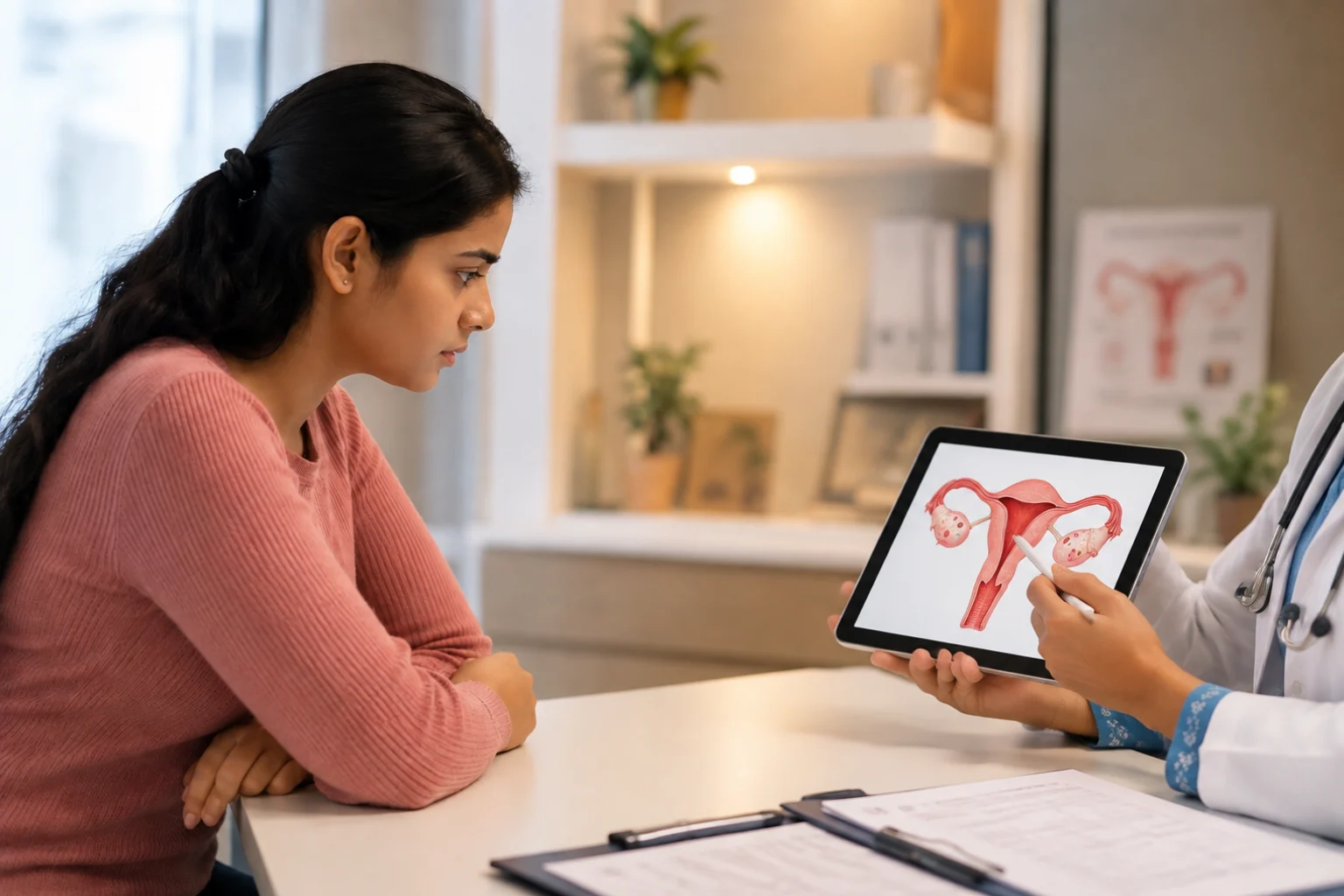
Picture this
It's 11 p.m. Her exam is in nine hours. The chapter is still unread, the phone is still lit up, and there's an empty chips packet next to a half-drunk cold drink. She missed her period again this month — the third time this year — and you've been telling yourself it's "just stress" or "just school."
You're not wrong that it's stress. You're also not wrong to wonder if it's something more.
Here's what might surprise you: doctors in Delhi, and separately, the world's leading hormone specialists, are looking at exactly this everyday scene — the late nights, the screens, the packaged snacks, the missed periods — and saying the same thing: this pattern is quietly driving a real rise in PCOS (also called PMOS or PCOD) among school-age girls. Not just in India. Everywhere.
This article is written for you, not for your doctor. No jargon, no scary numbers without context — just what's actually happening, why it's happening now, and what you can genuinely do about it starting tonight.
"Is this just an Indian thing, or is it everywhere?"
Fair question, and an important one — because if it were only local, you might assume it's about Indian food, or Indian parenting, or something specific to your city. It isn't.
In 2023, more than a thousand doctors, researchers and patients from six continents — including major medical bodies in the US, Europe and Australia — sat down together and rewrote the global rulebook on PCOS/PMOS. Their conclusion: this condition now affects roughly 1 in 10 women worldwide, and by their own estimate, around 8 in every 100 teenage girls. That's not an Indian statistic. That's the whole world, agreeing.
Separately, Indian researchers at AIIMS have been watching this play out up close, school by school:
- A three-year AIIMS Delhi study, which has screened over 4,000 children across seven schools, found that in private schools, as many as 40 to 45 out of every 100 girls are now overweight or obese — up sharply from what doctors were used to seeing "many years back," in their own words. In government schools it's lower, but climbing too — now up to 15 in 100.
- A separate pooling of 12 different Indian studies on teenage girls found PCOS/PMOS present in roughly 1 in 5 of them.
So no — this isn't an Indian problem being over-reported. It's a global pattern, and India is simply one of the places where doctors are now actively looking for it and finding it.
Why is this happening to this generation specifically?
Here's the honest, slightly uncomfortable answer: it's not really about hormones going wrong on their own. It's about a daily routine that's changed enormously in the last one generation, and hormones are just responding to it.
Think of it like this. Every cell in your daughter's body has tiny "locks" that let sugar in for energy, and insulin is the "key." When she moves her body regularly, eats real food, and sleeps properly, those locks turn smoothly. But late nights, hours of sitting still with a screen, and a diet heavy in packaged snacks and sugary drinks make those locks stiff and rusty. Her body compensates by pumping out more and more insulin keys to force the locks open.
That flood of extra insulin does something else, almost as a side effect: it tells the ovaries to produce more androgens (the hormones responsible for acne, extra facial or body hair, and irregular periods). That's the actual chain reaction behind a huge number of PCOS/PMOS cases in this age group — and it's exactly what both the AIIMS researchers and the international guideline point to: screen time, sedentary hours, disrupted sleep, and processed food, working together.
One thing worth knowing, because it surprises most parents: this can happen to a slim girl too. This isn't only about visible weight gain. A perfectly slim teenager with a heavy phone habit, late nights, and a snack-heavy diet can develop the exact same insulin problem underneath, invisibly.
Before you panic — an important pause
Here's the part we don't want you to skip, because it changes how you should read everything above.
A rising number of "cases" in the news does not automatically mean your daughter has PCOS/PMOS. In fact, the same international guideline that gave us that "8 in 100" global figure also went out of its way to say: do not diagnose this too quickly in teenagers.
Why? Because almost everything doctors look for — irregular periods, some acne, ovaries that look "polycystic" on a scan — is also just... normal puberty. Cycles are expected to be all over the place for the first couple of years after a girl's first period. Acne is expected. A teenage ovary naturally looks "spotty" on an ultrasound in a way that would be flagged as abnormal in an adult.
That's exactly why the world's PCOS experts created a specific "at risk" category, just for girls like this — not a diagnosis, not a label, just a note to keep watching and reassess properly once she's a bit older. It's a deliberately gentler, more honest way of handling an unclear picture, instead of slapping on a lifelong-sounding diagnosis based on one confusing ultrasound.
We've written about exactly how this age-appropriate diagnosis works, step by step, in PCOS/PMOS in Teenagers: Why Overdiagnosis Is a Real Risk — worth reading if a doctor has already used the word "PCOS" for your daughter and you're not sure it was the right call.
So what should you actually do? (Starting tonight, not "someday")
None of this needs a hospital visit to begin. Here's where real families actually start:
The single biggest lever, because it fixes sleep, cuts late-night snacking, and reduces sitting time all at once. A simple "phone charges outside the bedroom after 10" rule does more than any supplement.
Fighting over chips and cold drinks rarely works. Quietly changing what's actually in the house — fruit and nuts instead of packaged snacks within easy reach, water and buttermilk instead of sugary drinks as the default — works far better than a lecture.
It doesn't need to be a gym or a sport she hates. A walk with you after dinner counts. The goal is consistency, not intensity.
Don't focus on her weight. Watch instead for what actually matters — is her skin breaking out more than usual? Is hair growth increasing anywhere new? Are her periods genuinely irregular for her age (more on what "irregular" really means below)? These are the real signals, not the number on a weighing scale.
Academic pressure and body-image stress are, on their own, linked to worse hormonal symptoms. A daughter who feels criticised about her body will often eat worse and sleep worse, not better. Gentle and curious beats strict and silent, every time.
"But how do I know if it's actually PCOS, or just... being a teenager?"
This is the question that matters most, and here's a simple way to think about it, straight from the same international guidelines:
Irregular cycles are completely normal. Don't worry yet.
A cycle needs to repeat every 21 to 45 days to be considered "on track." Outside that range for a few cycles in a row is worth a chat with a doctor.
Now the window tightens to 21–35 days, or at least 8 periods a year.
Time to get her checked, regardless of anything else.
Alongside cycle irregularity, doctors also look for visible signs like new or worsening acne, or extra hair growth on the face, chin or body. Both things together — not just one — are what international guidelines say should raise real suspicion in a teenager. One alone is usually just puberty being puberty.
If several of these genuinely apply to your daughter, that's the moment for a proper, unhurried assessment — not a home Google search, and definitely not an unnecessary ultrasound. We go into exactly which tests are and aren't useful at this age in How PMOS Is Diagnosed, and the full mechanism behind why insulin matters so much in Insulin Resistance in PMOS: How to Test It, Read It, and Treat It.
What happens if it does turn out to be PCOS/PMOS?
Take a breath — this is genuinely manageable, and nothing here involves surgery or anything drastic. Depending on what's actually bothering her, options include:
The full detail on treatment, including the common fears parents have about the pill and fertility, is covered in PCOS/PMOS in Teenagers.
Quick answers to what you're probably still wondering
Genuinely both, and that's not a contradiction. More screening finds more cases — that's true. But the underlying risk factors (screen time, sedentary life, processed food) really have increased for this generation, so the real number is also rising, not just the reported one.
Not entirely, no. The insulin problem behind PCOS/PMOS can happen at a normal weight too. Watch her skin, hair growth and cycles rather than her weight.
Not directly, no single cause does. It's the ripple effect — less sleep, less movement, more snacking — that adds up to the hormonal changes doctors are seeing.
It's a fair ask. The same researchers flagging this issue are explicitly calling for schools to pay more attention to food environments, movement, and screen habits — this isn't only a "home" problem.
Dono sach hai. Zyada screening se zyada cases pata chalte hain, lekin asli risk — jaise screen time, kam movement, aur processed food — bhi genuinely badh gaya hai is generation mein. Isliye number sirf reporting ki wajah se nahi, sach mein bhi badh raha hai.
If you want a second, unhurried opinion
If any of this sounds like your daughter, you don't need to solve it alone tonight, and you don't need to panic either. A calm, proper assessment — not a rushed scan, not a scary label — is the right next step.
Dr. Shruti Shah's PMOS & Hormonal Health Clinic
1st floor, Darshan Orthopaedic Surgical Clinic & Maternity Home, Swami Vivekanand Rd, opp. Milap PVR Theatre, Malad West, Mumbai 400064
Phone: +91 93215 05185
Sources
- International Evidence-based Guideline for the Assessment and Management of Polycystic Ovary Syndrome 2023. Led by Monash University's CRE WHiRL, in partnership with ASRM, the Endocrine Society, ESE and ESHRE. https://www.monash.edu/medicine/mchri/pcos/guideline
- International evidence-based recommendations for polycystic ovary syndrome in adolescents. BMC Medicine 2025;23:151. https://link.springer.com/article/10.1186/s12916-025-03901-w
- The rise of PCOS in Australian and global context. Medical Journal of Australia, 2023. https://www.mja.com.au/node/20242
- AIIMS study finds rising PCOS, obesity among adolescent girls, flags excessive screen time and lifestyle risks. The Statesman, September 2026. https://www.thestatesman.com/lifestyle/health/aiims-study-finds-rising-pcos-obesity-among-adolescent-girls-flags-excessive-screen-time-and-lifestyle-risks-1503641903.html
- Up to 5% of teen girls may have PCOS, AIIMS Delhi finds in prelim screening of 4,000 school kids. ThePrint, September 2026. https://theprint.in/health/up-to-5-of-teen-girls-may-have-pcos-aiims-delhi-finds-in-prelim-screening-of-4000-school-kids/3050533/
- Sharma M, Khapre M, Saxena V, Kaushal P. Polycystic ovary syndrome among Indian adolescent girls – A systematic review and meta-analysis. Nepal Journal of Epidemiology 2021;11(3). https://www.ncbi.nlm.nih.gov/pmc/articles/PMC8560138/
Dr. Shruti Shah
Providing advanced women's health and hormonal wellness solutions. Your health is our prime priority.