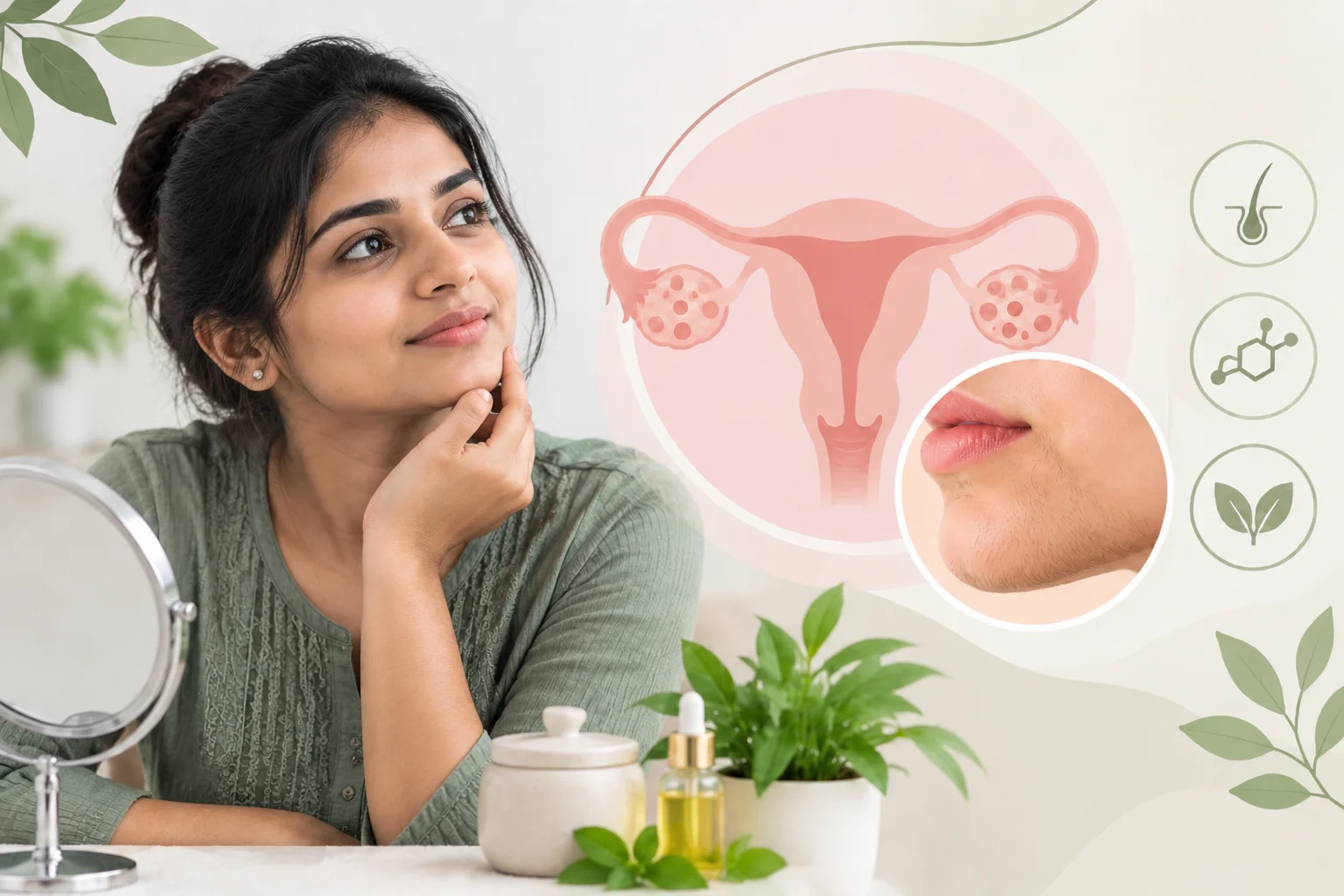
This article is for education. It doesn't replace a consultation with your doctor — some of the causes of sudden or severe facial hair growth need urgent medical evaluation (see the red-flags section below).
Why Does PCOS/PMOS/PCOD Cause Facial Hair?
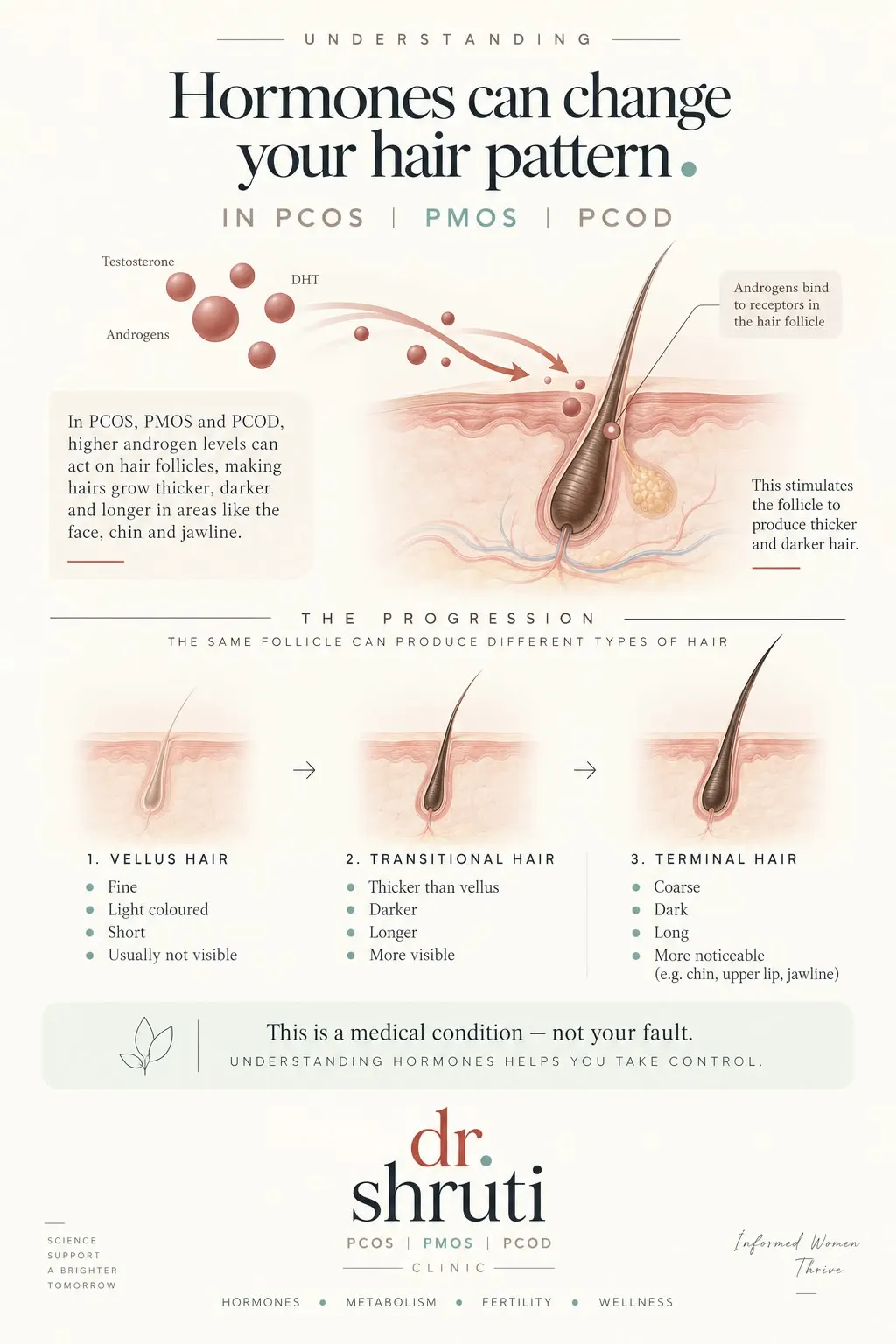
Facial and body hair growth is driven by androgens — hormones like testosterone and DHEA-S that everyone's body makes, women included, just in smaller amounts. In PCOS/PMOS/PCOD, two things push androgens higher than usual:
- The ovaries themselves produce more androgens than they should, as part of the hormonal imbalance that defines PCOS/PMOS/PCOD.
- Insulin resistance, present in most women with PCOS/PMOS/PCOD, makes the ovaries and adrenal glands produce even more androgen, and lowers a protein called SHBG that normally keeps testosterone "bound" and inactive — so more of it circulates freely in the blood.
That extra circulating androgen reaches hair follicles on the face, chin, upper lip, and jawline, and converts fine "peach fuzz" (vellus hair) into thicker, darker, faster-growing terminal hair — the coarse hair hirsutism is defined by.
How Common Is This, Really?
Very common — studies across Indian PCOS/PMOS/PCOD populations put hirsutism prevalence anywhere from 60% to over 80% of women with the condition, making it one of the most frequent reasons women first suspect (or get diagnosed with) PCOS/PMOS/PCOD in the first place. If you're dealing with this, you are one of a very large group of women, not an exception.
Is It PCOS/PMOS/PCOD Facial Hair, or Just Normal Peach Fuzz?
Every face has some fine, light, barely-visible vellus hair — that's normal and universal. Hirsutism is different: coarse, dark, curly terminal hair in a male-pattern distribution — chin, upper lip, sideburns, sometimes jawline and neck. Doctors often use a visual scoring tool called the Ferriman-Gallwey score to grade how much and where; a gynaecologist or dermatologist can assess this in one visit.
"But my testosterone came back normal — why do I still have facial hair?"
This is one of the most common and most confusing questions we hear, and it has a real answer: hair follicles can be more sensitive to androgens even when blood testosterone is technically "normal." This is because of local skin enzymes (like 5-alpha reductase) that convert normal-range testosterone into a much more potent form right at the follicle. Normal blood testosterone does not rule out PCOS/PMOS/PCOD-driven hirsutism — it just means the cause is partly about follicle sensitivity, not only hormone quantity. This needs a doctor's interpretation, not a Google diagnosis.
Temporary Hair Removal: What Actually Works (and What Backfires)
These methods don't touch the hormonal cause, but they're what most women reach for first. Here's the honest comparison:
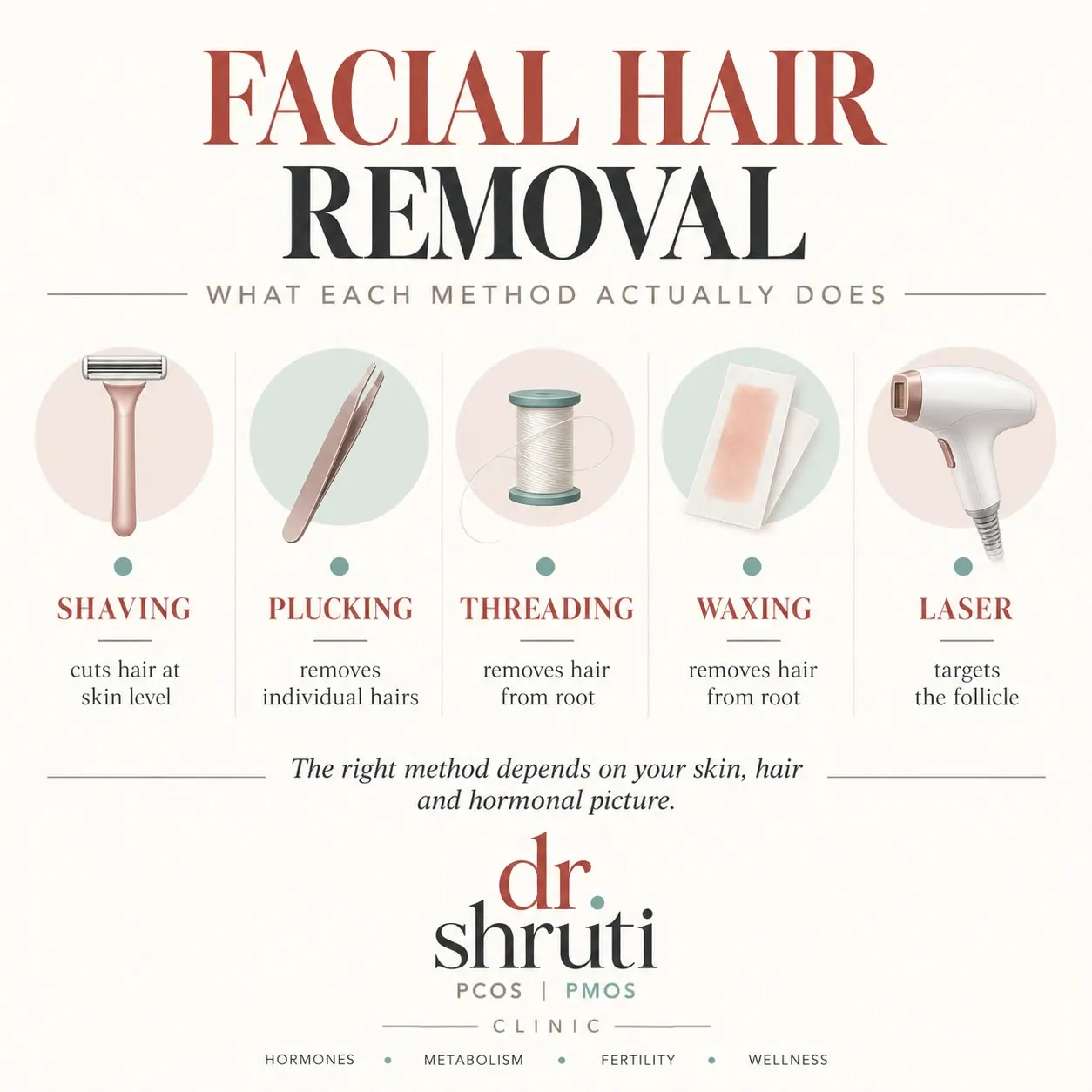
- Shaving — Does not make hair grow back thicker or darker. That's a myth (shaving cuts hair at a blunt angle, which feels coarser as it grows out, but the follicle and growth rate are unchanged). Fastest, cheapest, and safest for daily use — but regrowth shows in 1–3 days.
- Plucking / tweezing — Removes hair from the root, lasts longer than shaving, but repeated plucking on the same follicle can cause skin damage, scarring, ingrown hairs, and folliculitis. Fine occasionally; not a long-term strategy for dense hirsutism.
- Threading — Popular and effective for shaping (upper lip, sideburns), gentler on skin than plucking at scale, but time-consuming for larger areas and regrowth returns in 2–4 weeks.
- Waxing — Clears larger areas at once, but painful on facial skin and risks irritation, ingrown hairs, and post-inflammatory pigmentation on Indian skin tones if done incorrectly.
- Depilatory creams — Convenient, but facial skin is more reactive than body skin. Always patch-test 24 hours before full use.
- At-home IPL devices — Far lower-powered than clinical devices, works poorly on coarse PCOS hair and medium-to-deep skin tones, and carries real risks of burns or patchy pigmentation.
Bottom line: All of the above manage hair that's already grown. None of them slow down why it's growing. For that, you need either hormonal treatment, permanent hair reduction, or — for most PCOS/PMOS/PCOD patients — both.
Medical Treatments: Addressing the Hormone, Not Just the Hair
Spironolactone
An anti-androgen medication that blocks testosterone's effect at the hair follicle. It's one of the most commonly prescribed medical treatments for PCOS/PMOS/PCOD-related hirsutism worldwide. It takes time — most women don't see a visible difference in hair growth for 3 to 6 months, since it works on the next hair growth cycle, not the hair already on your face. Requires a doctor's prescription, dose titration, and monitoring (it affects potassium levels and isn't safe in pregnancy).
Combined Birth Control Pills
Certain oral contraceptives reduce ovarian androgen production and raise SHBG (the protein that "mops up" free testosterone), and are a first-line hormonal option for many women with PCOS/PMOS/PCOD-related hirsutism — often combined with spironolactone for a stronger effect. Which formulation is right depends on your full health picture, not something to self-select.
Topical Eflornithine Cream
A prescription cream (the active ingredient behind the international brand Vaniqa, available in India as Eflora Cream) applied directly to facial hair-growth areas. It doesn't remove hair — it slows how fast it grows back, so it's used alongside a removal method like threading or laser, not instead of one. Visible slowdown usually takes 4–8 weeks of consistent use.
Metformin
Primarily an insulin-sensitising medication for PCOS/PMOS/PCOD's metabolic side, not a direct hirsutism treatment. By improving insulin resistance, it can modestly reduce androgen levels over time in some women, but its effect on visible facial hair is usually smaller and slower than spironolactone or laser.
GLP-1 Medications (Ozempic, Mounjaro)
These are metabolic and weight-management tools, prescribed within a supervised medical plan for suitable PCOS/PMOS/PCOD patients — not a hirsutism treatment. Meaningful, sustained weight and insulin improvement can indirectly lower androgen levels for some women, but this is a slow, secondary effect, not a reason to start a GLP-1 for facial hair alone.
Does Weight Loss Reduce PCOS/PMOS/PCOD Facial Hair?
Improving insulin resistance — through sustainable weight and metabolic management — can lower circulating androgens in some women, which may modestly soften new hair growth over months. But existing hair doesn't disappear with weight change alone, and many women with well-managed weight still have significant hirsutism because follicle sensitivity, not just hormone level, is driving it. Weight and metabolic care is one part of a PCOS/PMOS/PCOD treatment plan — not a replacement for hair-specific treatment.
Natural and Lifestyle Approaches: What the Evidence Actually Supports
- Spearmint tea: Small studies suggest regular spearmint tea intake may modestly lower free testosterone and androgen markers in some women with PCOS/PMOS/PCOD-related hirsutism, likely by mild anti-androgen action. Evidence is limited and effect sizes are small — worth discussing with your doctor as a supportive habit, not a stand-alone treatment.
- Inositol (myo-inositol/D-chiro-inositol): Well-studied for improving insulin sensitivity and ovulation in PCOS/PMOS/PCOD; its effect on hirsutism specifically is indirect and modest, working through the same insulin-androgen pathway as weight management.
- Zinc: Some evidence links zinc deficiency to worsened hirsutism, and supplementation has shown modest benefit in a few small studies — but routine high-dose supplementation without a confirmed deficiency isn't advisable without medical guidance.
- Diet: A lower-glycemic, whole-food diet supports the same insulin-androgen pathway as metformin and weight management — a genuinely useful long-term lever, but a slow one, and not a substitute for hair-specific treatment if hirsutism is significant.
Realistic expectation: lifestyle and natural approaches support your hormonal health broadly and can modestly help — but for most women with visible PCOS/PMOS/PCOD hirsutism, they work best combined with medical treatment and hair reduction, not instead of it.
Permanent Hair Reduction: Laser vs Electrolysis
This is the only category of treatment that acts on the hair itself for the long term.
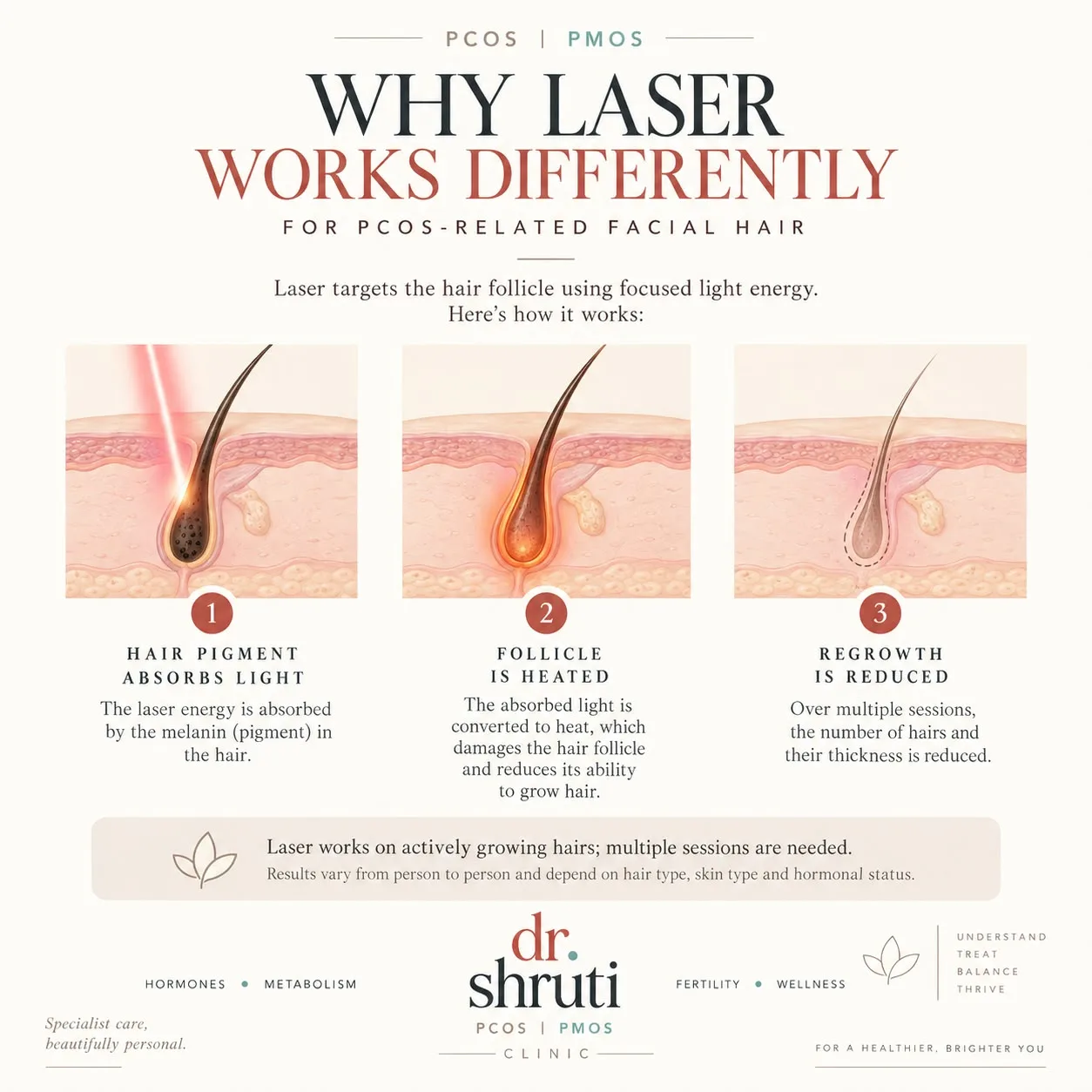
Laser Hair Reduction (LHR) — How It Works
Laser targets melanin (pigment) in the hair shaft using focused light energy:
- Step 1: Hair Pigment Absorbs Light — The laser energy is selectively absorbed by melanin in the hair.
- Step 2: Follicle is Heated — Absorbed light converts to controlled heat, damaging the hair follicle and reducing its ability to grow hair.
- Step 3: Regrowth is Reduced — Over multiple sessions timed with active growth phases, hair diameter and density decrease significantly.
Works fastest on larger areas (full face, jawline, neck). Because PCOS/PMOS/PCOD-driven follicles remain under continuous androgen influence, periodic maintenance sessions help keep results permanent and skin smooth.
Electrolysis
Inserts a fine probe into each individual follicle and delivers targeted energy — genuinely permanent, follicle by follicle, and works on any hair colour or skin tone, including for hair too light or fine for laser to target well. Slower and more time-intensive for larger areas like a full face, but the gold standard for finishing touches, stray hairs, or areas laser doesn't fully clear.
In practice, for PCOS/PMOS/PCOD facial hirsutism, most dermatologists use laser for the bulk reduction on larger areas, with electrolysis as a precise finishing tool for stubborn or resistant hairs — the two are complementary, not competing.
"Paradoxical Hypertrichosis" — Why Some People Report Laser Making Hair Worse
In a small number of cases, laser hair treatment at the wrong energy setting, on the wrong skin type, can actually stimulate finer surrounding vellus hair into thicker terminal hair instead of reducing it — a real, documented phenomenon called paradoxical hypertrichosis. It happens far more often with underpowered or poorly-calibrated devices used on medium-to-dark skin tones without adjusting for skin type. This is exactly why the device and the operator's skill matter as much as the treatment category — and why PCOS/PMOS/PCOD hormonal treatment alongside laser reduces this risk, since it's controlling the androgen drive that the laser alone can't touch.
Why Skin-Type-Specific, Multi-Wavelength Laser Technology Matters
Most of India has medium-to-deep skin tones (Fitzpatrick IV–VI), and a large share of laser hair reduction problems — burns, patchy pigmentation, paradoxical hair growth, uneven results — trace back to devices or settings built for lighter skin, used without adjustment.
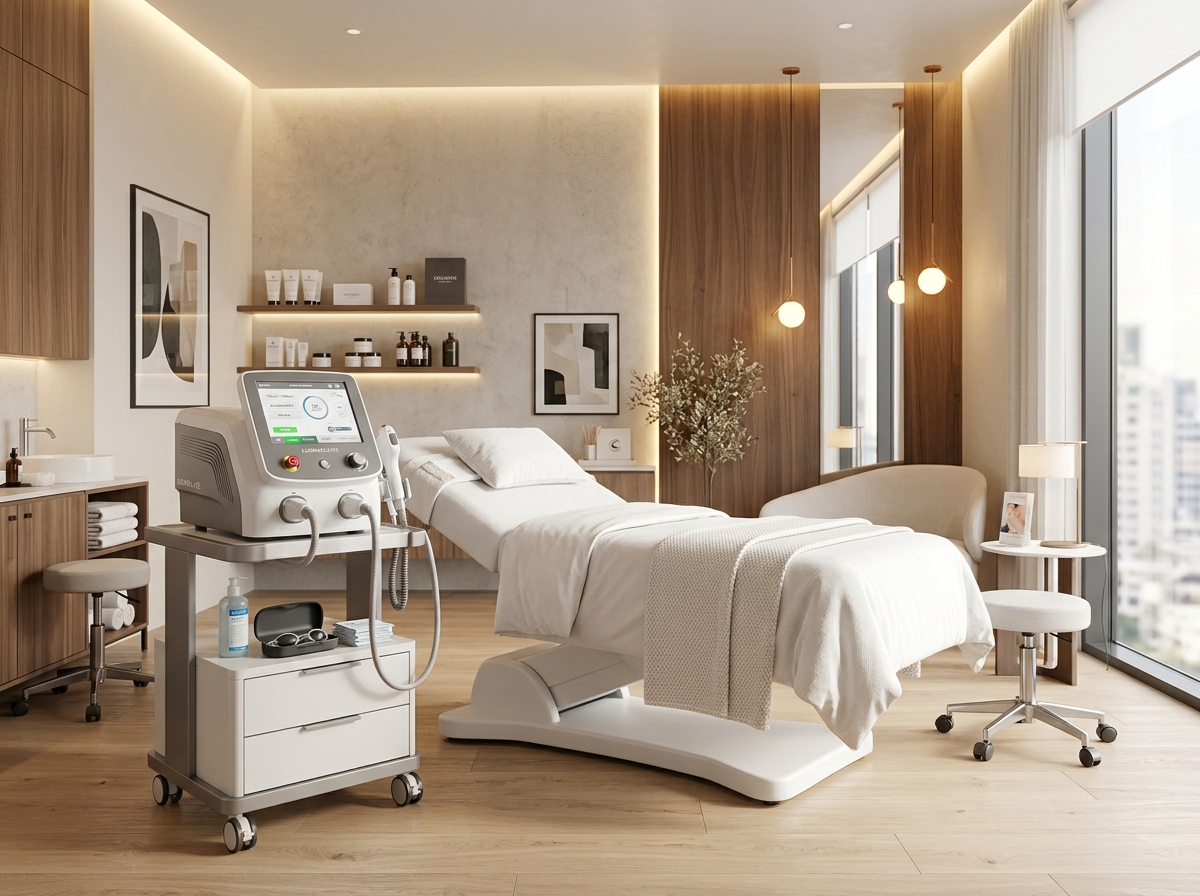
At Dr. Shruti Shah's PCOS & Hormonal Health Clinic, this is exactly why we refer our patients to our sister clinic, Mumbai Cosmetic Centre (MCC), for laser hair reduction rather than treating PCOS/PMOS/PCOD hirsutism with a one-size-fits-all device:
- USFDA-approved laser platform — cleared for safety and efficacy, not an unregulated import.
- Painless technology — no numbing cream drama, no dreading the appointment.
- 4-wavelength system — different wavelengths penetrate to different depths and target different hair thicknesses and skin depths, so the treatment is matched to your hair coarseness and follicle depth, not a single generic setting.
- Calibrated to your specific skin type — settings are adjusted for your individual Fitzpatrick skin type before every session, which is the single biggest factor in avoiding burns, pigmentation, and paradoxical hair growth on Indian skin.
For PCOS/PMOS/PCOD patients, this means the hormonal root cause is managed here at the PCOS/PMOS/PCOD clinic, while the physical hair reduction happens next door with technology genuinely built for the skin tones and hair types we see every day in Mumbai.
The Emotional Side: You're Allowed to Feel This

Facial hair doesn't just sit on the skin — it sits in the mirror every morning, in how close you let people get, in what you avoid saying yes to. Many women describe anxiety before dates, hesitating before selfies, or dreading a partner noticing stubble before a wax appointment.
This is a real, valid emotional weight, not vanity, and it deserves to be treated as seriously as any other PCOS/PMOS/PCOD symptom. You don't have to justify wanting this treated — feeling comfortable, radiant, and confident in your own skin is reason enough.
If facial hair is affecting your confidence, relationships, or mental health, that's worth saying out loud to your doctor — it changes how urgently and how comprehensively your treatment plan should be built, not just cosmetically but hormonally.
When to See a Doctor Urgently (Red Flags)
Most PCOS/PMOS/PCOD hirsutism develops gradually over months to years. See a doctor promptly, rather than trying home remedies first, if you notice:
- Sudden, rapid-onset facial or body hair growth over weeks, not years
- Hirsutism appearing alongside deepening voice, significant muscle gain, balding, or clitoral enlargement (signs of virilization)
- New hirsutism starting well after your 30s with no prior history
These patterns can occasionally point to a hormone-producing tumor of the ovary or adrenal gland, and need urgent hormonal workup — not because this is common, but because ruling it out is quick and important.